First Ripple: Earlier identification of UK children with SEND

Self-Teaching Unlocked!
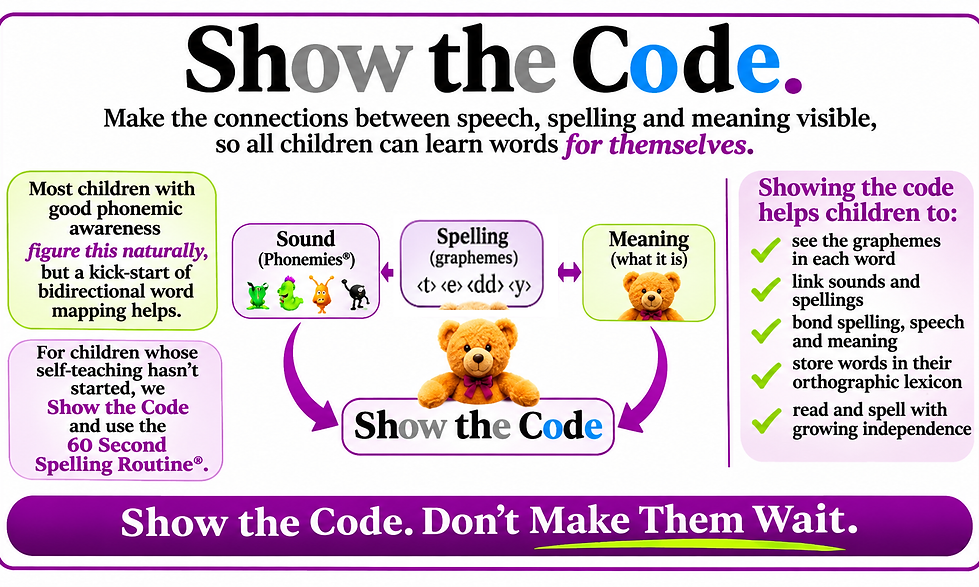
MyWordz®, powered by the Ortho-GraphiX® algorithm, enables bidirectional word mapping, connecting speech to print AND print to speech. Through the 60-second routine, learners bond phonemes, graphemes and meaning, enabling words to be stored in their orthographic lexicon for instant recognition when reading and accurate retrieval when spelling.
Unlocking Self-Teaching
Show the Code. Don't Make Them Wait.
In England, children identified as at risk through Dys-Code®7, 9 or 11 will already have experienced years of synthetic phonics instruction. They will have been explicitly taught a limited set of grapheme–phoneme correspondences (GPCs), predominantly from print to speech, yet they have not developed the self-teaching processes needed for independent reading and spelling.
They may read a sentence such as ‘He jumped up and down’ with ease, while struggling to spell those same words accurately when writing.
This distinction matters.
To store words in the orthographic lexicon, enabling instant recognition during reading and accurate retrieval during spelling, speech sounds, graphemes and meaning must become bonded. These connections need to support word learning in both directions.
The initial teaching of approximately 100–120 GPCs, from the 500+ correspondences skilled readers come to understand without being explicitly taught them all, is intended to kick-start self-teaching. Children should increasingly acquire orthographic knowledge through their own encounters with written language.
But what happens when that self-teaching process hasn't started?
More of the Same Is Not the Answer
For children who have already spent years receiving synthetic phonics instruction, another sequence of explicit GPC teaching, spelling rules and exceptions does not necessarily address the barrier preventing independent word learning.
This is particularly problematic for spelling, where learners must move from speech to print, identifying phonemes and retrieving the graphemes needed to represent them.
A learner may recognise a word instantly when reading it but be unable to retrieve its spelling when writing.
The problem is not simply how much of the code has been taught. It is whether learners are using their existing knowledge to acquire and store new mappings independently.
Unlocking Self-Teaching
Rather than continuing to teach more and more correspondences explicitly, we can make the code accessible for any word, whenever it is needed. Using MyWordz®, powered by the Ortho-GraphiX® bidirectional word-mapping algorithm, learners can see the code for any English word, whenever they need it.
Through the 60-second word mapping routine, learners bond phonemes, graphemes and meaning, enabling them to store words in their orthographic lexicon, so they can recognise them instantly when reading and retrieve their spellings accurately when writing.
Crucially, the goal is not simply to learn individual words. Or to learn spelling rules. It is to unlock self-teaching, enabling learners who have struggled despite years of synthetic phonics instruction to begin acquiring and storing new word mappings independently, in both directions, without relying on further explicit instruction.
They do not have to wait until a particular GPC appears in a teaching sequence. They can explore words that matter to them, whether encountered in reading or needed for writing.
Morphology and etymology can be explored when relevant and useful, rather than becoming compulsory additional layers of instruction.
The objective is not to teach learners every correspondence they might encounter. It is to enable them to acquire the correspondences they need through self-teaching.
Independence Is the Goal
Unlocking self-teaching means enabling learners who have struggled despite years of synthetic phonics instruction to begin acquiring and storing new word mappings independently.
Success is not measured by how many GPCs have been explicitly taught, but by whether learners can increasingly recognise words instantly when reading, retrieve their spellings accurately when writing, and independently store unfamiliar words in their orthographic lexicon. We don't need learners to remain dependent on instruction. We need to unlock their capacity for self-teaching.
It is a different approach to overcoming the barriers that prevent independent orthographic learning.
Instead of measuring progress primarily through the number of GPCs explicitly taught, we focus on whether learners are increasingly able to recognise, spell and independently learn words they have not been directly taught.
This is particularly important for children identified through Dys-Code®5, 7, 9 and 11, where screening and assessment must lead to meaningful support rather than simply identifying difficulties and prescribing more of the same.
We don't need learners to remain dependent on instruction. We need to unlock their capacity for self-teaching.
Show the Code. Don't Make Them Wait.